For decades, I worked with whatever notebook I could grab. Spiral-bound school pads, cheap spiral notebooks, the occasional Moleskine that felt like a splurge. Each one had its own problems: paper that bled through, covers that fell off, pages that refused to lie flat. It took me years to understand that the best daily journal recommendations come from matching the tool to the task, not from following trends or buying the most expensive option. After testing dozens of journals and notebooks over the past twenty years, I have developed a clear sense of what works for different kinds of daily writing.
Why Your Journal Choice Matters More Than You Think
The right journal can make the difference between a writing practice that sticks and one that fades after a week. A notebook that bleeds through on every page discourages you from writing on both sides. A spine that cracks after a month makes the book feel cheap and disposable. Small frustrations add up. Over time, they erode the habit you are trying to build. The best daily journal recommendations I can offer come from understanding how you actually write, not from how you imagine you should write.
I have kept journals for travel, for morning pages, for project notes, and for creative drafting. Each type demanded something different from the notebook. A traveler needs something slim that tucks into a jacket pocket. A morning pages writer needs plenty of paper that handles fountain pen ink without feathering. A project note-taker needs a system that lets them reorganize pages. No single notebook does all of that well. That is why my daily journal recommendations always start with a question: what kind of writing are you actually doing?
The Fountain Pen Friendly Options
If you write with fountain pens, paper quality becomes your main concern. Tomoe River Paper is the gold standard here. It is thin, lightweight, and handles wet ink with almost no bleed-through or feathering. The Hobonichi Techo uses Tomoe River Paper, and it has been my go-to for daily journaling for several years. The book lies flat, the paper takes fountain pen ink beautifully, and the layout options include daily pages that give you room for long entries. The downside is price. Hobonichi Techo books are not cheap, and the paper is so thin that you can see writing from the other side. For many writers, that translucency is a dealbreaker.
Nanami Paper also uses Tomoe River Paper, and their notebooks have a more classic look than the Hobonichi Techo. They offer blank, grid, and lined options. If you want the Tomoe River Paper experience in a simple notebook, Nanami Paper is worth trying. Another strong option is Clairfontaine. Their paper is thicker than Tomoe River Paper, still fountain pen friendly, and more opaque. Clairfontaine notebooks come in many sizes and bindings, and they are more affordable than the Japanese imports. For a fountain pen writer on a budget, Clairfontaine is one of the best daily journal recommendations I can give.

Rhodia is another reliable choice. Their staple-bound pads lie flat, the paper is smooth and fountain pen friendly, and the orange covers make them easy to spot in a bag. Rhodia pads work well for quick notes and drafts, but the staple binding means they do not hold up as well for long-term journal keeping. For a daily journal that you will keep for years, a sewn binding is better.
Notebooks That Travel Well
Travel changes everything. A hardcover notebook that works fine on a desk becomes heavy in a backpack. A pocket-sized notebook fills up fast if you write more than a few lines a day. For travel, I recommend the Traveler's Notebook system. It consists of a leather cover and multiple inserts that you can swap out. You can carry several small notebooks in one cover, each for a different purpose: one for daily journaling, one for sketches, one for planning. The inserts come in many paper types, including blank, grid, and lined. You can buy refills from many brands, including Muji and Field Notes. The system is flexible, and the leather cover develops character over time.
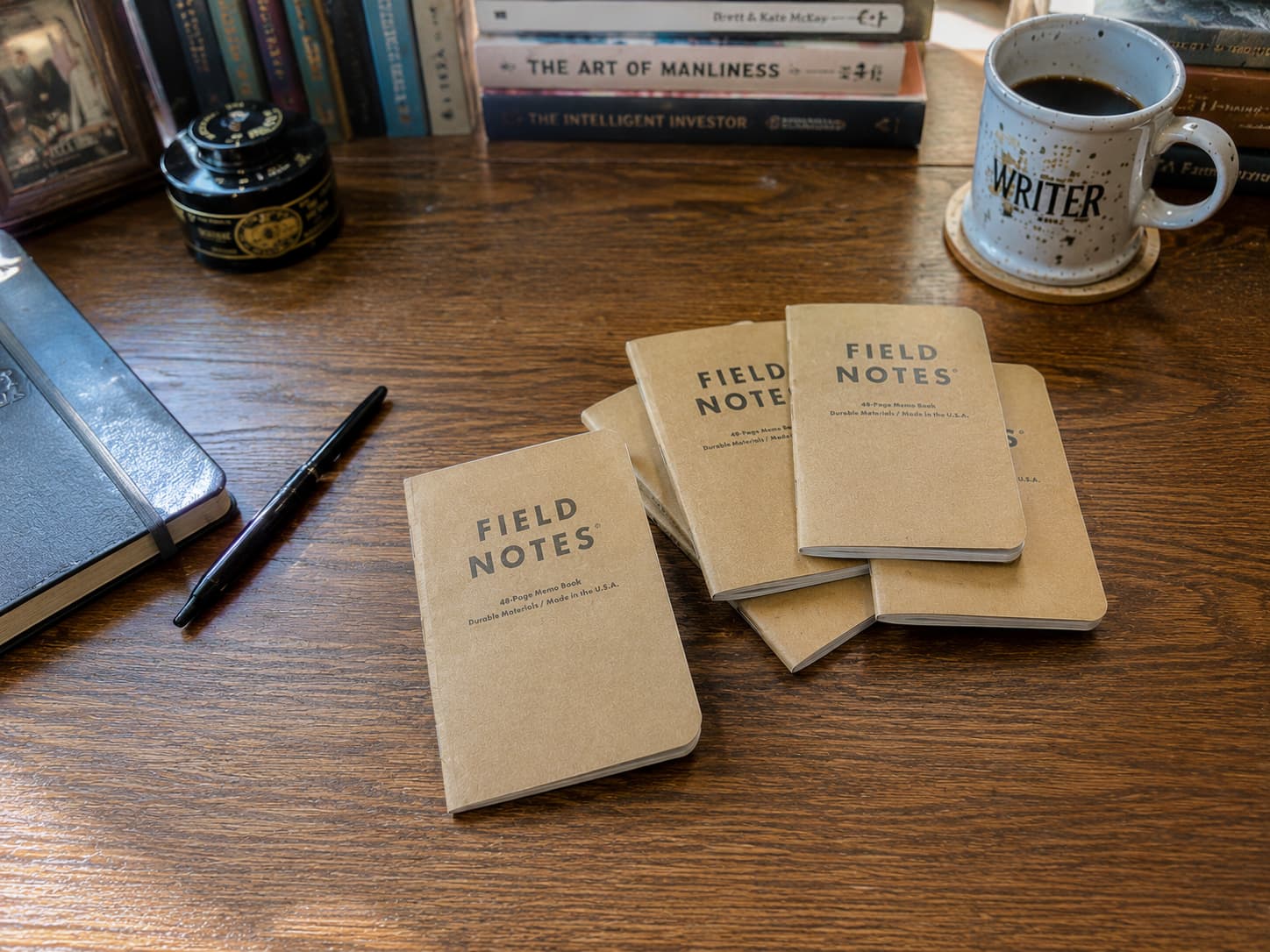
Field Notes notebooks are small, rugged, and inexpensive. They fit in a back pocket and come in many special editions. The paper is not fountain pen friendly, but it works fine with ballpoint pens, gel pens, and pencils. The Pilot G2 is a great match for Field Notes paper. The G2 writes smoothly and dries quickly, and the ink does not bleed through the thin pages. Field Notes notebooks are not built for long entries. They are built for quick captures, lists, and observations. If you are the kind of writer who jots down thoughts on the go, Field Notes is a solid choice.
The Muji notebooks are another travel-friendly option. They are plain, cheap, and come in many sizes. The paper handles fountain pen ink fairly well, though not as well as Tomoe River Paper or Clairfontaine. Muji notebooks are great for testing layouts and sizes without spending much money. I have used Muji notebooks for travel journals, and they held up well enough for the trip.
The Bullet Journal and Planner Crowd
Bullet journaling has become popular for a reason. It combines planning, journaling, and habit tracking in one notebook. For this style, you need a notebook with a dot grid or a blank page, a strong binding that lies flat, and paper that handles writing on both sides. Leuchtturm1917 is the most famous choice for bullet journaling. Their notebooks come in many colors, have numbered pages, and include a table of contents and an elastic band to mark your place. The paper is good for most pens, but it can show ghosting with wet fountain pens. Leuchtturm1917 notebooks are well-made, and they have a loyal following. I have used several Leuchtturm1917 notebooks for daily journaling, and they work well for mixed use: some planning, some writing, some doodling.
Archer & Olive notebooks are another strong option for bullet journaling. They have thicker paper that handles fountain pens and markers with almost no ghosting. The covers are sturdy and come in many designs. Archer & Olive notebooks are more expensive than Leuchtturm1917, but the paper quality is noticeably better for heavy ink users. For a bullet journalist who uses water-based markers or fountain pens, Archer & Olive might be the better choice.
Dingbats notebooks are also worth mentioning. They use tree-free paper made from stone, which is waterproof and tear-resistant. The paper handles fountain pen ink well, and the notebooks lie flat. Dingbats are a newer brand, but they have gained a following among bullet journalists and daily journalers who want something different.
Specialty Notebooks for Specific Needs
Some writers need more than blank pages. The Rocketbook is a reusable notebook that works with Pilot Frixion pens. You write, scan the pages with the Rocketbook app, and then wipe the pages clean with a damp cloth. This is not for someone who wants a permanent journal. But for someone who takes a lot of notes and wants to digitize them, the Rocketbook is clever and practical. I have used it for project notes, and the scanning feature works well. The Frixion pens write smoothly, and the pages erase cleanly.
Baron Fig notebooks have a minimalist design and good paper quality. They come in a few sizes and grid patterns. Baron Fig is not as famous as Leuchtturm1917 or Moleskine, but their notebooks are solid and the company has a strong design focus. I have used a Baron Fig notebook for a daily journal, and it held up well. The paper is fountain pen friendly, and the cover is soft and flexible.
Paperblanks and Peter Pauper Press make decorative notebooks that look like antique books. They have elaborate covers and gilt edges. The paper quality is decent, but not as good as Tomoe River Paper or Clairfontaine. These are good choices if you want a journal that feels special and looks beautiful on a shelf. For serious daily writing, I would pick a more functional notebook, but for a gift or a special project, Paperblanks and Peter Pauper Press are hard to beat.
Exacompta is a French brand that makes notebooks with a good balance of quality and price. Their paper is fountain pen friendly, and their bindings are strong. Exacompta notebooks are not as easy to find in the United States, but they are worth seeking out. Carson Dellosa is another brand that makes affordable notebooks for students and writers. Their composition notebooks are cheap and work fine for ballpoint pens and pencils. They are not fancy, but they get the job done.
How to Choose Your Daily Journal
After all these years, my daily journal recommendations come down to a few simple guidelines. First, think about the pen you use most. If you use a fountain pen, choose a notebook with Tomoe River Paper, Clairfontaine, or Archer & Olive. If you use a Pilot G2 or a Lamy Safari with a fine nib, you have more options. Moleskine notebooks are a classic choice, but their paper has gotten thinner and more prone to bleed-through in recent years. I do not recommend Moleskine for fountain pen users. For ballpoint and gel pen users, Moleskine works fine.
Second, consider the binding. Sewn bindings last longer than glued bindings. Staple bindings work for pads and pocket notebooks, but they do not hold up for long-term journaling. Spiral bindings are fine for school work, but they look messy after a few months.
Third, think about size. A pocket notebook like Field Notes fits in a jacket. A5 is a popular size for daily journaling because it fits in most bags and gives you a good amount of writing space per page. A4 is large and good for long-form writing at a desk. B5 is a middle ground that many Japanese brands use. The Hobonichi Techo comes in A5 and A6 sizes. I prefer A5 for daily journaling.
Finally, do not be afraid to try something new. The best daily journal recommendations are the ones that keep you writing. If a notebook feels precious or intimidating, you will avoid using it. If a notebook feels cheap and disposable, you will not want to keep it. Find the balance that works for you. I have gone through phases with Leuchtturm1917, Hobonichi Techo, and Traveler's Notebook. Each one served a purpose at the time. The notebook is never the point. The writing is the point.
For someone starting out, I would suggest buying one mid-range notebook and one cheap notebook. Use the mid-range one for your daily journal and the cheap one for experimentation. See which one you reach for more often. Pay attention to how the paper feels under your pen, how the notebook lies open on your desk, and how you feel when you write in it. Over time, you will develop a sense of what you need. And when you find it, stick with it. A good notebook can be a companion for years.